Research
We build evaluation models, so we spend most of our time on a hard question: how do you know an evaluator is right? These are our own experiments and findings — judge reliability, reward model benchmarks, and the failure patterns we see inside production AI systems.
We publish the negative results too — the techniques that didn't work go out alongside the ones that did. Code and data are open where the underlying data allows it. Four papers, two open benchmarks, a failure-mode ontology, and more on the way.
Papers
-
arXiv:2609.06444
PreprintDecomposing LLM-Judge Uncertainty to Target Expert Labels
Ryan Lail ·
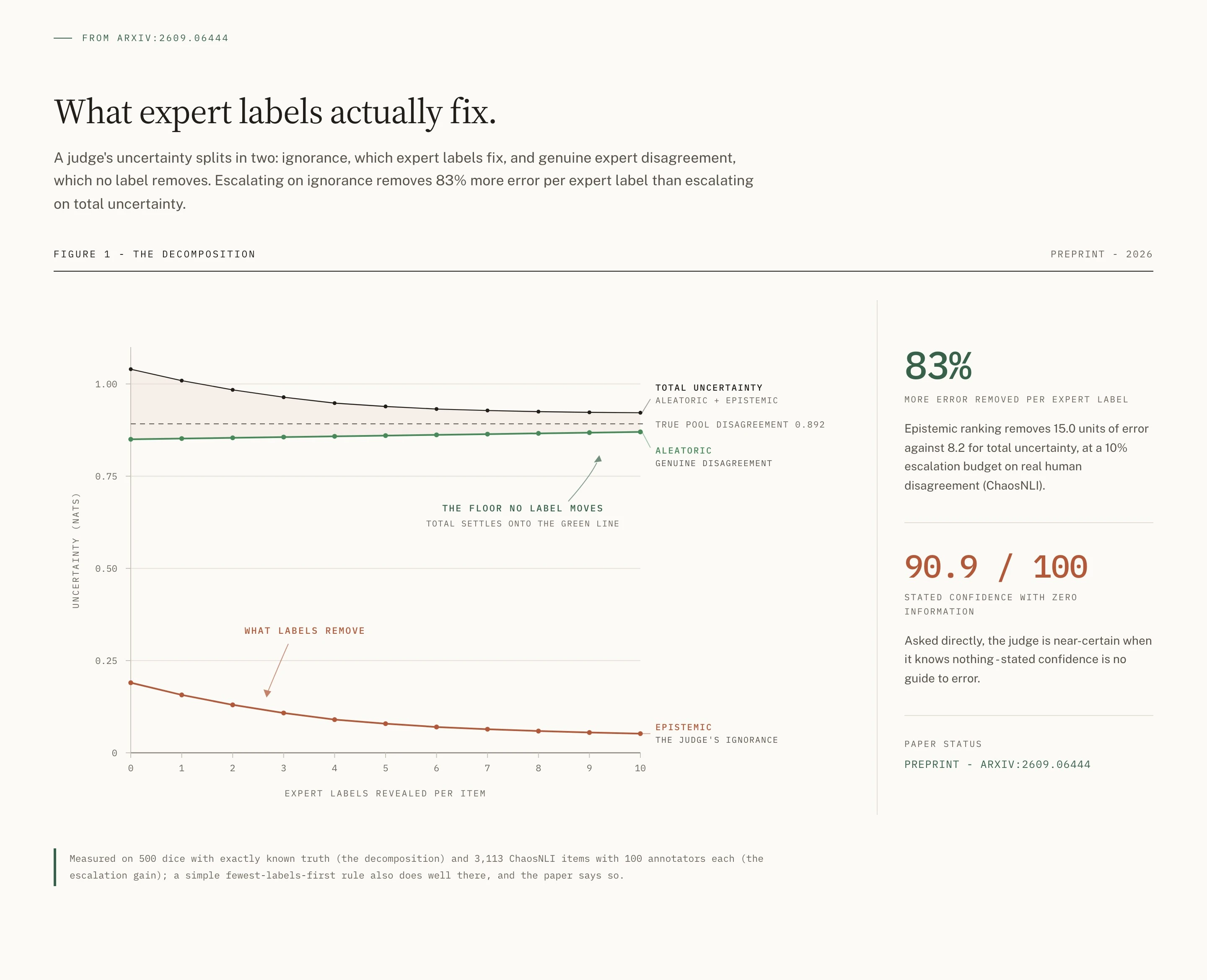
A judge's uncertainty splits in two: the genuine disagreement your experts would have anyway, and the judge's own ignorance of where the bar sits - which labels can fix. A small Bayesian model trained on the labels you already collect separates the two in closed form, with no extra judge calls. Targeting the fixable half removed 83% more error per expert label than escalating on total uncertainty - and a judge's stated confidence, for comparison, barely predicts its errors at all.
-
arXiv:2608.31017
NeurIPS 2026 workshop paperOne note in three: a verified census of three deployed AI scribes, and the instrument that counted it
Sebastian Fox, Luke Markham, Ryan Lail, Michael Karotsieris ·
Accepted at the NeurIPS 2026 Workshop on GenAI for Health: Agentic Systems, Clinical Trust, and Future Potential - Sydney, December 2026.
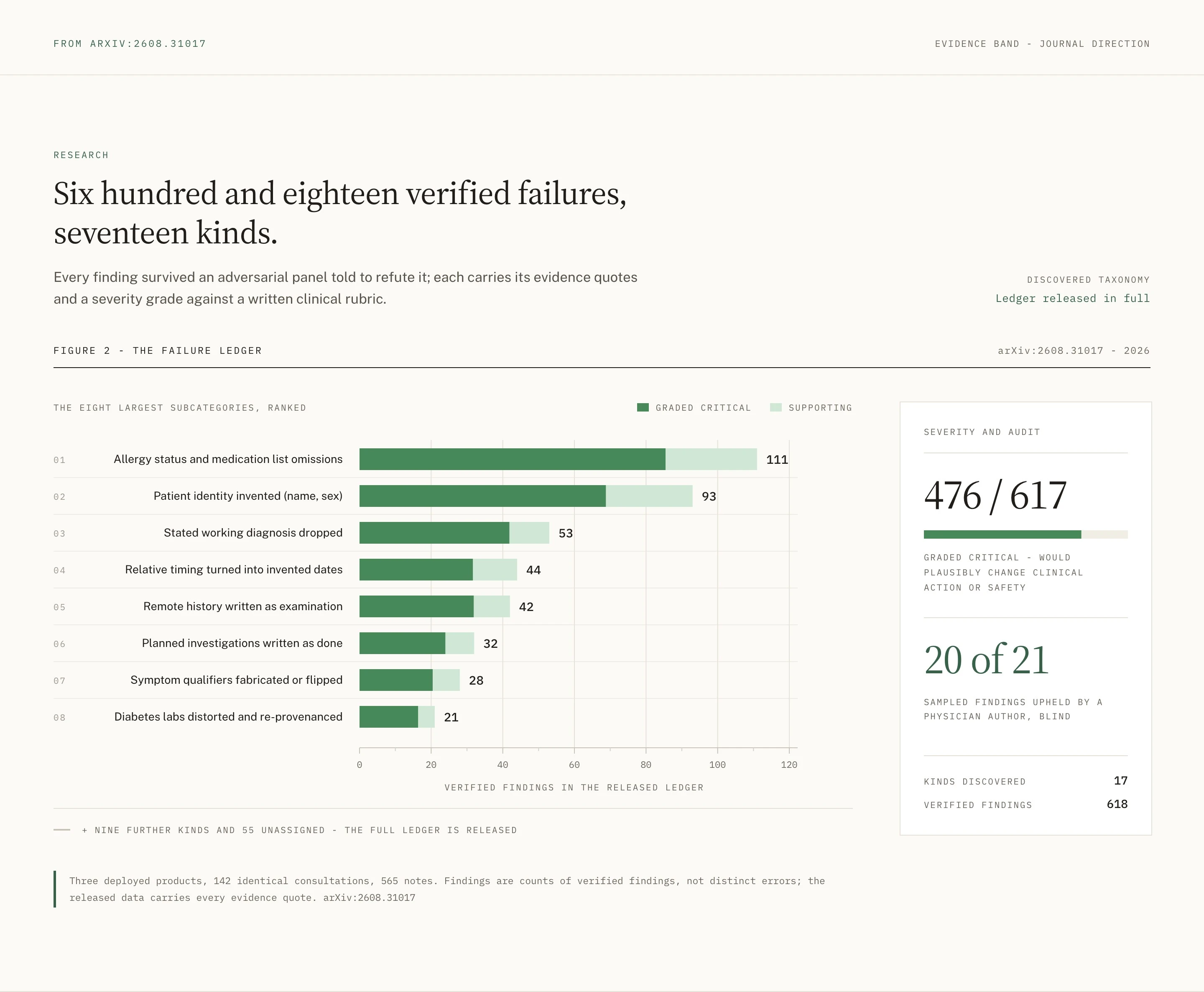
We audited three commercial AI scribes on the same 142 consultations - 565 notes from recorded UK and US encounters plus authored scenarios. Every candidate error went through an adversarial two-model panel told to refute what it could, then blinded clinician adjudication. One note in three carries a verified failure, concentrated in allergy and medication information, invented patient identity, and history written up as examination on telephone consultations that can contain none.
-
arXiv:2608.31016
NeurIPS 2026 workshop paperLLM Judges Verify Presence, Not Absence: Omission Blindness in AI Clinical Notes and What Recovers It
Sebastian Fox, Luke Markham, Ryan Lail, Michael Karotsieris ·
Accepted at the NeurIPS 2026 workshop TAE (Trust-AI-Eval): Can We Trust AI Evaluation? - Sydney, December 2026.
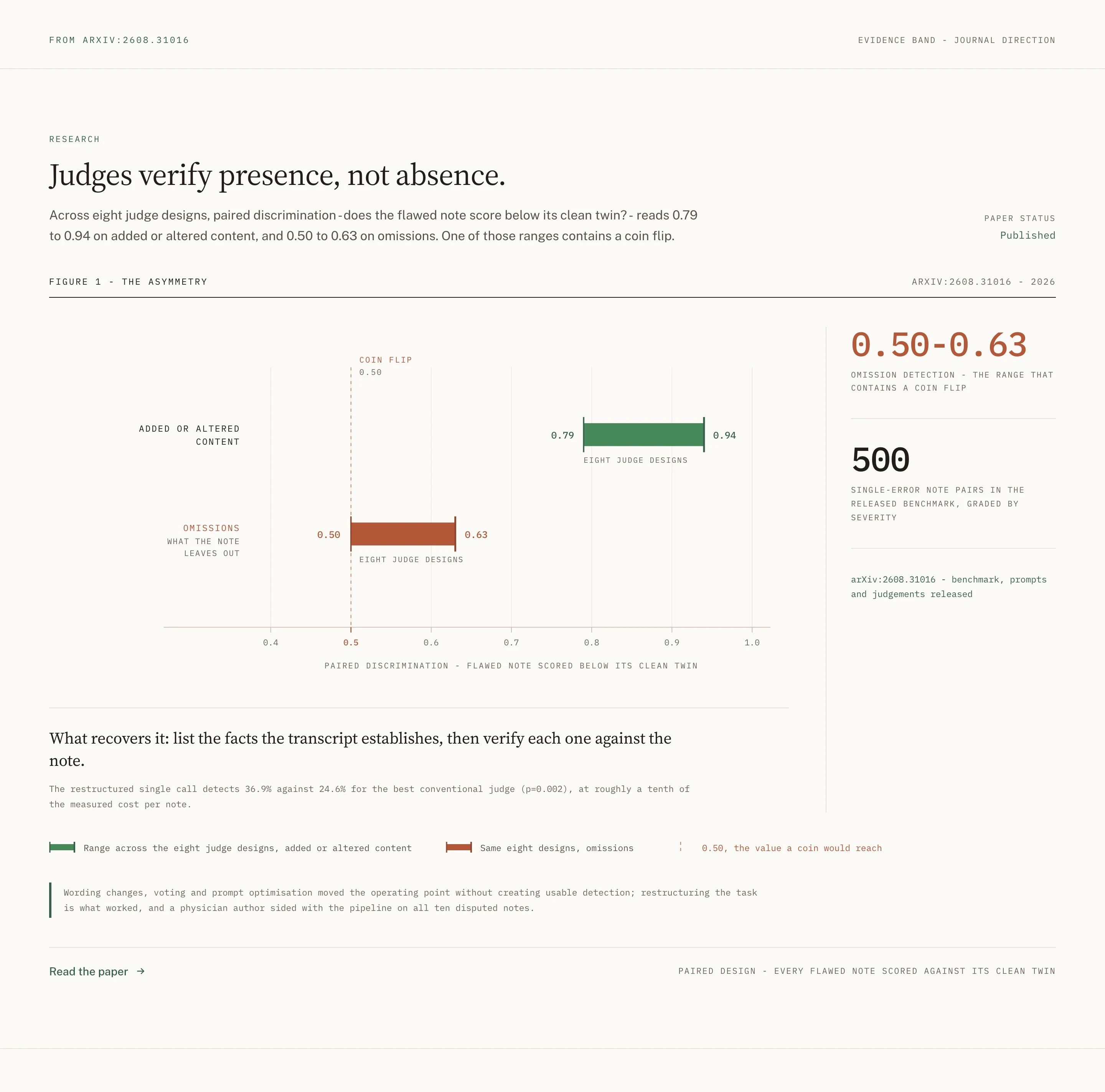
The dominant AI scribe error is omission, and LLM judges barely detect it: across eight judge designs, paired discrimination reads 0.79-0.94 on added or altered content but only 0.50-0.63 on omissions, where 0.5 is a coin flip. Prompt wording, voting and GEPA optimisation move the operating point without creating usable detection. Restructuring the task recovers it - list the facts the transcript establishes, then check the note for each.
-
arXiv:2604.13717
ICML 2026 workshop paperOn Cost-Effective LLM-as-a-Judge Improvement Techniques
Ryan Lail, Luke Markham ·
Accepted at two ICML 2026 workshops — Statistical Frameworks for Uncertainty in Agentic Systems, and Combining Theory and Benchmarks — Seoul, July 2026.
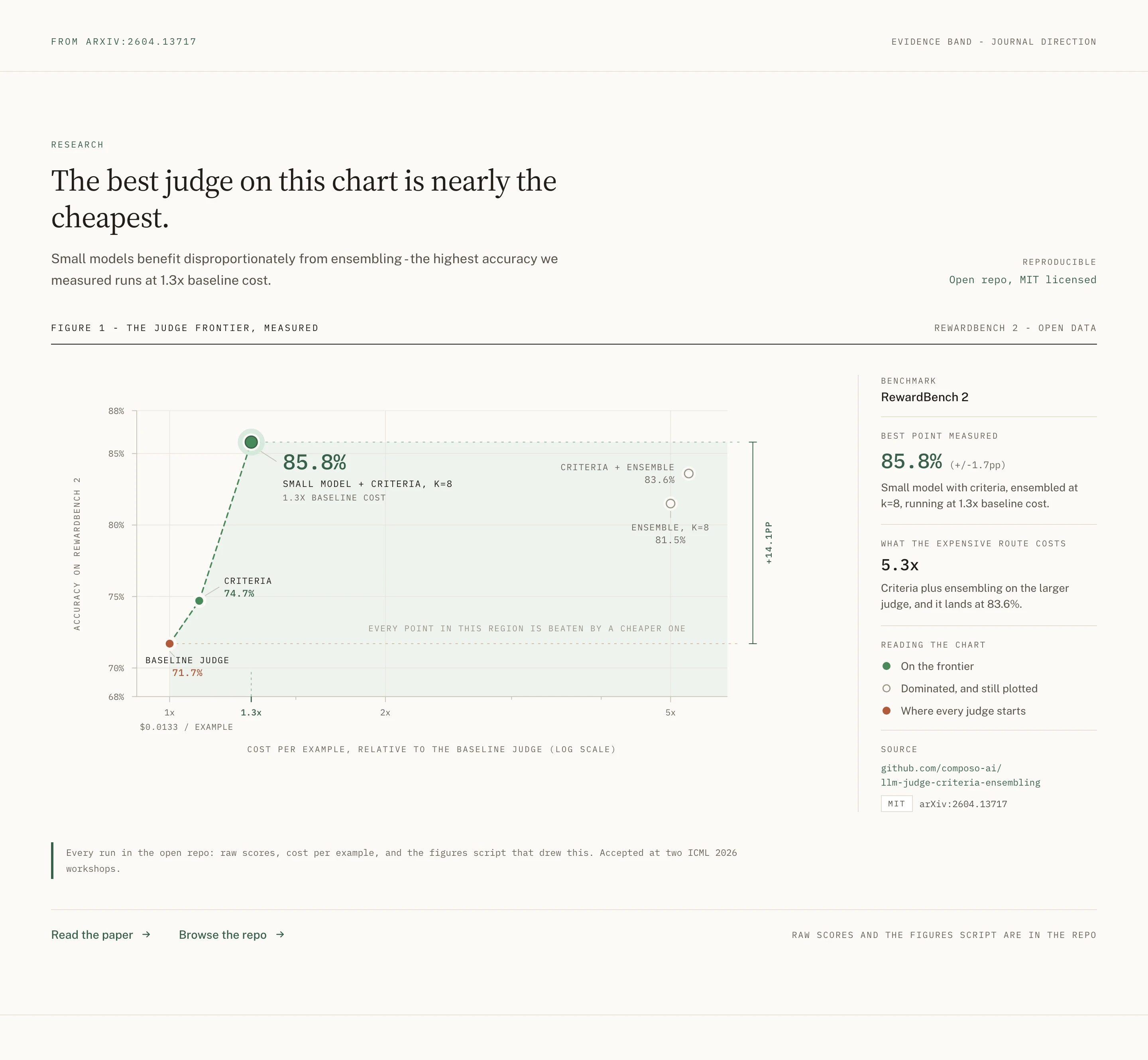
We tested four drop-in techniques for improving LLM-as-a-judge accuracy on RewardBench 2. Two of them — task-specific criteria injection and ensembling — reach up to 85.8% accuracy, 13.5 points above a 71.7% baseline, at 1.3x baseline cost, with the gains holding across both the OpenAI GPT and Anthropic Claude families. No fine-tuning required. The techniques that didn't win are published alongside the ones that did.
In the pipeline
What we're writing up now. Preprints are added above the day they go public.
- In progress
What happens to a judge's validity when you optimise it for agreement
Write-ups
Inside 847 Production Clinical AI Notes
Seb's talk at the AI Engineer World's Fair: what we found auditing notes from deployed AI scribes, why an excellent LLM judge shares the scribes' blind spot, and the loop that recovers it.
Seb Fox
A Living Map of LLM Failure Modes: Dominant, Emerging, Squashed
Most failure-mode analysis treats failures as a static taxonomy. In production they're a living distribution - some dominant, some emerging, some being squashed by recent fixes. Here's a clustering pipeline that tracks all three.
Luke Markham
An Ontology of LLM Failure Modes
A structured taxonomy of 60+ failure modes across eight categories, synthesizing recent research into a practical framework for understanding how and why large language models fail.
Luke Markham
LLMs: Great Witnesses, Terrible Judges
LLM-as-a-judge consistency is largely illusory. The same hallucination produces wildly different scores depending on scale configuration, undermining evaluation trust.
Ryan Lail
Working with frontier teams
Everything on this page comes from the same small team, working with domain experts - clinicians first, and specialists in other fields where quality is a matter of judgement. The craft is the instrument: certain-correct answer keys, single-error task design, adversarial filtering before a human ever grades.
If you work on human data, post-training or evals and want expert-graded data, an independent benchmark, or evaluation on tasks where the right answer takes an expert to recognise, we would like to hear from you.
Talk to the foundersLooking for practical guides instead? Read the blog.